
David Barsamian on the movie The Battle of Algiers
Joe Richey | Jan 14, 2010
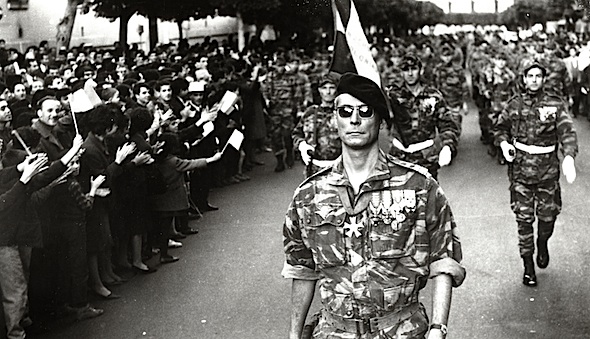
Scene from the movie The Battle of Algiers
The Battle of Algiers highlights the popular resistance to French occupation of Algeria beginning in 1954 and culminating in independence eight years. France had conquered Algeria in 1830, clinging to it as its longest held colony until 1962. Produced in 1965 by Gillo Pontecorvo and his collaborator Franco Solinas, it is a classic from early cinema verité. It is also a favorite of the U.S. occupying General David Petraeus, who relates to the experience of French Commander Lt. Colonel Philippe Mathieu charged by his government to rid Algiers of small cells of insurgents.
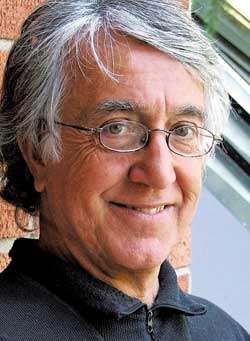
David Barsamian
There are parts in the screenplay where one need only replace the pronouns with contemporary corollaries.
(See the complete movie script.)
David Barsamian spoke about The Battle of Algiers at the Laughing Goat Coffeehouse on January 11th. Tim Butler and Joe Richey recorded his remarks.
Barsamian (two minutes into the talk): This film is path breaking. It is cinema verité, a style that developed in the 1960s and Gillo Pontecorvo’s was in its vanguard. It’s a black and white film, handheld cameras, and very grainy film stock. The cameras are moving, so you get the sense that this is a documentary. In fact so many people thought that this film was a documentary that Pontecorvo was compelled to put a disclaimer at the beginning of the film: that there was not one moment of documentary footage in this particular film.
Cinema verité is a very simple but authentic style of filmmaking. And we don’t have, in this film you’ll see, we don’t delve into the deep psychological ruminations of the protagonist who falls in love with his childhood sweetheart or whatever. There’s none of that here.
While saying that, this is a deeply romantic film. It is about the romance of revolution, about liberation. I don’t want to idealize it too much but it is also a choral symphony and a work of great poetic imagination.
Edward Said, the great Palestinian American scholar and writer, calls The Battle of Algiers one of the greatest political films ever made. I think it’s simply one of greatest films ever made.
A little bit about the film itself. The main character is actually one of the founding members of the FLN, the National Liberation Front of Algeria. His name was Saadi Yacef. Yacef joined the FLN in 1954, and by 1956 he was in charge of the Casbah, the Arab populated old city of Algiers.
Yacef wrote a book 9Souvenirs de la Bataille d’Alger( 1962)]. He got in touch with the Italian filmmaker, Pontecorvo. They decided to make a film. He plays himself in this film. He’s known as El-hadi Jaffa. He’s very suave and debonair. He speaks flawless classical Arabic as opposed to another Algerian character who is his polar opposite, Ali la Pointe an illiterate street-tough, very much like Malcolm X, a two-bit hood who becomes radicalized when he is imprisoned by the French. So you see that kind of juxtaposition between the two characters.
There’s also a little boy who will win your heart, Petit Omar, little Omar. He is in fact Saadi Yacef’s nephew who is killed. All of these are real characters, Zora, Jamila, the women bombers in the film are based on actual historical Algerian protagonists.
This film was banned by the French government for many years even though it won The Golden Lion Award in 1966 at Venice.
The Algerian Revolution also influenced Frantz Fanon of Martinique. If you want to learn more about this you can read his work, The Dying Colonialism (1965), and The Wretched of the Earth (1961), as well as the work of the great Pakistani scholar, Eqbal Ahmed.
I want to read a line or two from the film.
Terrorism in the eyes of the beholder. We are a nation obsessed with the whole notion of terrorism and there is a sequence here in which one of the leaders of the FLN is asked by a journalist:
“Isn’t it a dirty thing to use women’s baskets to carry bombs to kill innocent people?”
This is a question that is often posed in the corporate media by the pundits. Here is the answer from the Algerian man:
“And you? Doesn’t it seem even dirtier to you to drop napalm bombs on defenseless villages with thousands of innocent victims? It would be a lot easier for us if we had planes. Give us your bombers, and we’ll give you our baskets.”
The film begins at the end. And then comes to another conclusion which is very dramatic and totally unexpected. You see toward the last frames of the film: the Algerians are crushed, the revolt is decimated, their leaders are executed, exiled and jailed. Everything seemed hopeless. And then magically out of that hopelessness the revolt arises again, and ultimately leading to independence for Algeria in 1962.
There’s a very interesting sequence here because the French used torture extensively in Algeria, as they did in Indochina, and Colonel Mathieu is asked about it by a journalist.
This sounds like, a journalist talking to Rumsfeld or Wolfowitz or Gates or Obama today.
“Let’s try to be precise then. The word “torture” does not appear in our orders. We have always spoken of interrogation as the only valid method in a police operation directed against unknown enemies.”
There you have that classic kind of bureaucratese of avoiding the answer.
You can see some similarities between the Colonel, who actually Pontecorvo presents in a very sympathetic way, he seems quite reasonable very much like Petraeus, McCrystal very smooth-talking, suave, debonair with a cigarette dangling in a very retro anecdote. But the same kind of thing – – the military commander who is struggling with the operational imperatives his mission, resisting the restraints of morality; for example, having to engage in torture which he denies is torture, calling it just an alternative form of interrogation. So there are some similarities between Petraeus and McCrystal and Colonel Mathieu.
Tom Peters adds: The American translation of cinema verité was “cinema truth.” If you’re looking for other examples of it you might want to see Jean-Luc Godard’s Sympathy for the Devil (1968), and Medium Cool, (1969) the latter being the first American cinema verité.
Italian filmmaker Bruno Bossio was in the audience and he mentioned that currently there is a Franco Solinas prize awarded each year for the best screenplay in Italy.
Tom Peters: Do you want to make any remarks about how it relates to the political situation today?
Barsamian: No historical situations are exactly analogous but I think you can see the resistance to a foreign occupation and maybe you can draw some lessons about what the Americans are trying to do in Afghanistan and Iraq, and in other countries, Yemen and Somalia, trying to impose their will upon a population that is not amiable or agreeable to being occupied.
The French situation in Algeria is a little unusual in that, as I said in my opening remarks, it was an example of settler colonialism. Over a million and a half French citizens came from metropolitan France to Algeria to settle. Albert Camus was among them, by the way. So there was a very strong lobby to keep Algeria French. And that’s why they fought so hard to keep it. Algeria also had big gas and oil reserves.
But the price that Algerians paid was simply staggering. Over a million people were killed between 1954 and 1962, a million Algerians in a population of 10 million. The French casualties were miniscule in comparison. In that way it does resemble other wars of occupation – Iraq, Afghanistan – where hundreds of thousands if not millions have been killed and handfuls of Americans and others have been killed.
Joe Richey: Why is this film shown at West Point today?
Barsamian: To demonstrate to American officers in training the difficulties of conducting counterinsurgency campaigns in populations that are hostile and resistant to being occupied. It shows the difficulties of carrying out conventional military operations where the advantage actually goes to the defender because of knowledge of terrain and natural allies within the Kasbah. So the Kasbah here just means locality or town area. Even though the French had tremendous firepower, tanks helicopters, automatic weapons and thousands and thousands of troops, the Algerian resistance had the advantage.
